Find a distant sign or a branch that is not moving. Look at it through your binoculars while standing, then sit down and rest your elbows on your knees. If the view settles, you have learned something useful before spending any money: support makes a difference with the pair you already own.
Hand movement becomes more visible through magnification. Fatigue adds to it, particularly when you keep looking up for several minutes. A shaky view does not, by itself, mean the binoculars are faulty. Start by changing how you hold them, then check the adjustments and consider extra support if you still need it.
Get comfortable before raising the binoculars
Stand with your feet comfortably apart and your knees relaxed. You can put one foot a little ahead of the other if that helps your balance. There is no need to force yourself into a rigid pose. You want a position you can hold without thinking about it constantly.
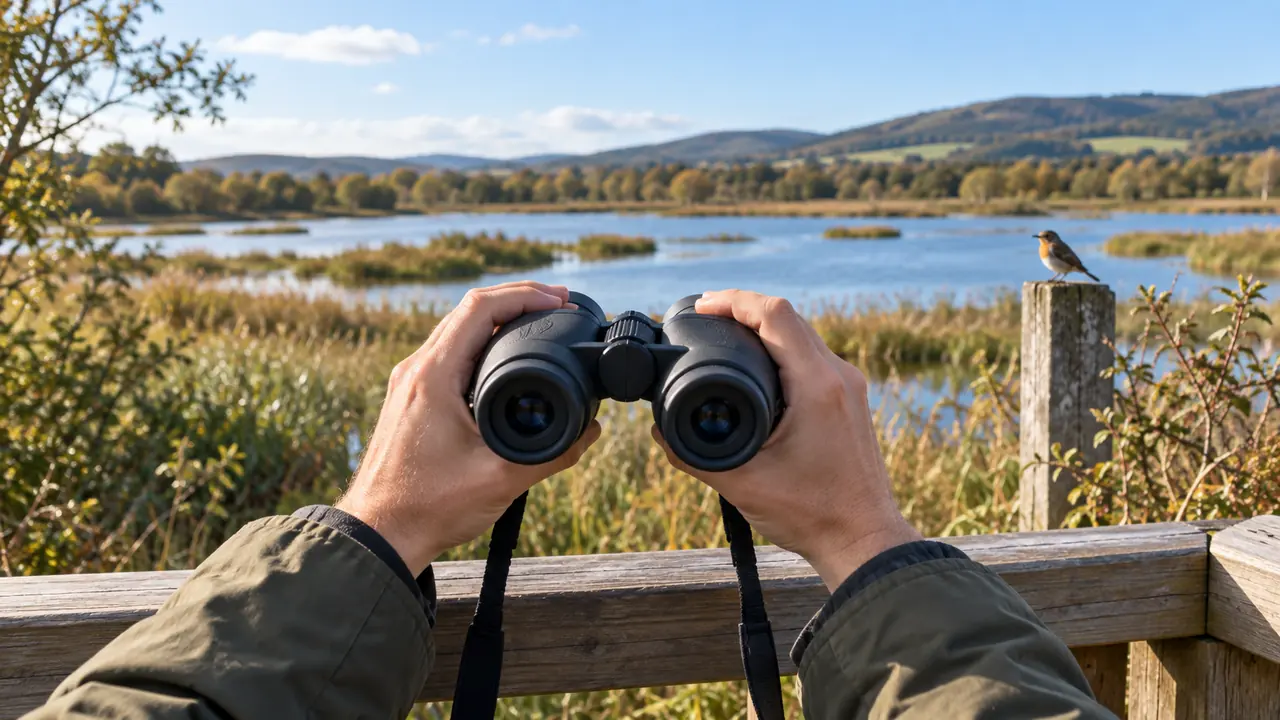
Lift the binoculars to your eyes instead of bending your head forward to meet them. Use both hands and let your elbows come closer to your body. Holding your elbows far out to the sides gives your shoulders more work to do. After a while, that effort shows up in the view.
Keep a firm but comfortable grip. Squeezing harder rarely helps once the binoculars are secure. If your hands or shoulders start to ache, lower the pair and relax before trying again. You may get a clearer look in several short observations than in one long, strained attempt.
Use whatever support is available
A bench is useful. So is a solid wall or a tree you can lean against comfortably. Support your body, hands, or wrists without pressing the binoculars awkwardly against a hard surface. The aim is to take some of the work away from your arms.
When seated, try resting your elbows on your knees. Adjust until you can look ahead without folding your neck into an uncomfortable angle. A position that works for watching a pond may be unsuitable for looking high into a tree. Change position as the subject changes.
Notice what happens when you breathe. Holding your breath for too long makes the whole exercise tense. Breathe normally while finding the subject, then see whether a relaxed exhale helps the image settle. If you catch yourself bracing every muscle, put the binoculars down for a moment.
Repeat the comparison with a fixed object. It is easier to judge improvement when the thing you are watching is not moving as well. Try sitting, standing, and leaning against a support before deciding that you need an accessory.
Check the fit for your eyes
Bring the barrels closer together or farther apart until you see one comfortable field of view. If you are struggling to merge two images, holding more tightly will not solve the adjustment problem. Take your time with this while looking at a stationary subject.
Set the eyecups for your glasses and your preferred viewing position. People wearing glasses often need the eyecups lowered, while those without glasses may need them extended. Check your model's instructions. The useful setting is the one that lets you see the field comfortably, without black edges appearing as your position shifts.
Follow the manufacturer's procedure for focusing and setting the diopter. The order depends on the design, so a generic instruction to “close one eye” is not enough. Once the diopter is set correctly, use the normal focusing control as intended for that model.
Try to distinguish movement from softness. An image that moves around is different from one that stays blurry even when the binoculars are supported. If careful adjustment does not resolve persistent blur or double images, have the binoculars checked rather than trying to compensate with your grip.
Give your arms a break
Pay attention to when the shake begins. If the first look is comfortable but the image wanders after several minutes, tired arms may be part of the problem. Lower the binoculars between observations. Locate a moving subject with your eyes before raising them again when that is practical.
Weight alone does not tell you how easy a pair will be to hold. A heavier instrument may feel settled initially and become tiring later. A compact pair can be light but awkward for your hands. The balance and the places where your fingers rest matter too.
Magnification changes the experience. Higher power makes small hand movements more apparent. If you are comparing binoculars, spend some time holding each pair rather than judging only the detail visible in a quick glance. With fixed-power binoculars, you cannot simply turn the magnification down; posture and support are the adjustments available to you.
Sort out the strap before adding equipment
Adjust the neck strap so you can raise and lower the binoculars comfortably. Excess slack can leave them swinging as you move. A strap that is too short makes you fight it every time you try to look through the eyepieces. Neither helps an unhurried observation.
A harness may make carrying the binoculars more comfortable on longer outings. It does not automatically steady the image once they are at your eyes. Judge it first as a way to carry the weight and keep the instrument accessible, then decide whether it suits your usual walks.
For longer observations from one place, consider a compatible tripod or monopod setup. Check the binoculars' mounting arrangement before buying an adapter. A tripod adds support but also adds something to carry and set up. That trade-off makes more sense beside a viewing spot than on a walk where you stop briefly and move on.
Try the inexpensive changes first: a more comfortable grip, elbows supported, correct eyecup settings, and shorter periods with your arms raised. Use the same distant object to compare the results. If sitting down gives you the view you wanted, a place to sit may be all the extra equipment you need.